

重要
混合选项需要企业版计划。
- 控制平面(LangSmith UI、API 和编排)在 LangChain 的云中运行,由 LangChain 管理。
- 数据平面(您的和智能体工作负载)在您的云中运行,由您管理。
| 组件 | 职责 | 在哪里运行 | 谁管理它 |
|---|---|---|---|
| LangChain 的云 | LangChain | |
| 您的云 | 您 |
工作流程
Supported Compute Platforms: Kubernetes.
For setup, refer to the Hybrid setup guide.
For setup, refer to the Hybrid setup guide.
Architecture
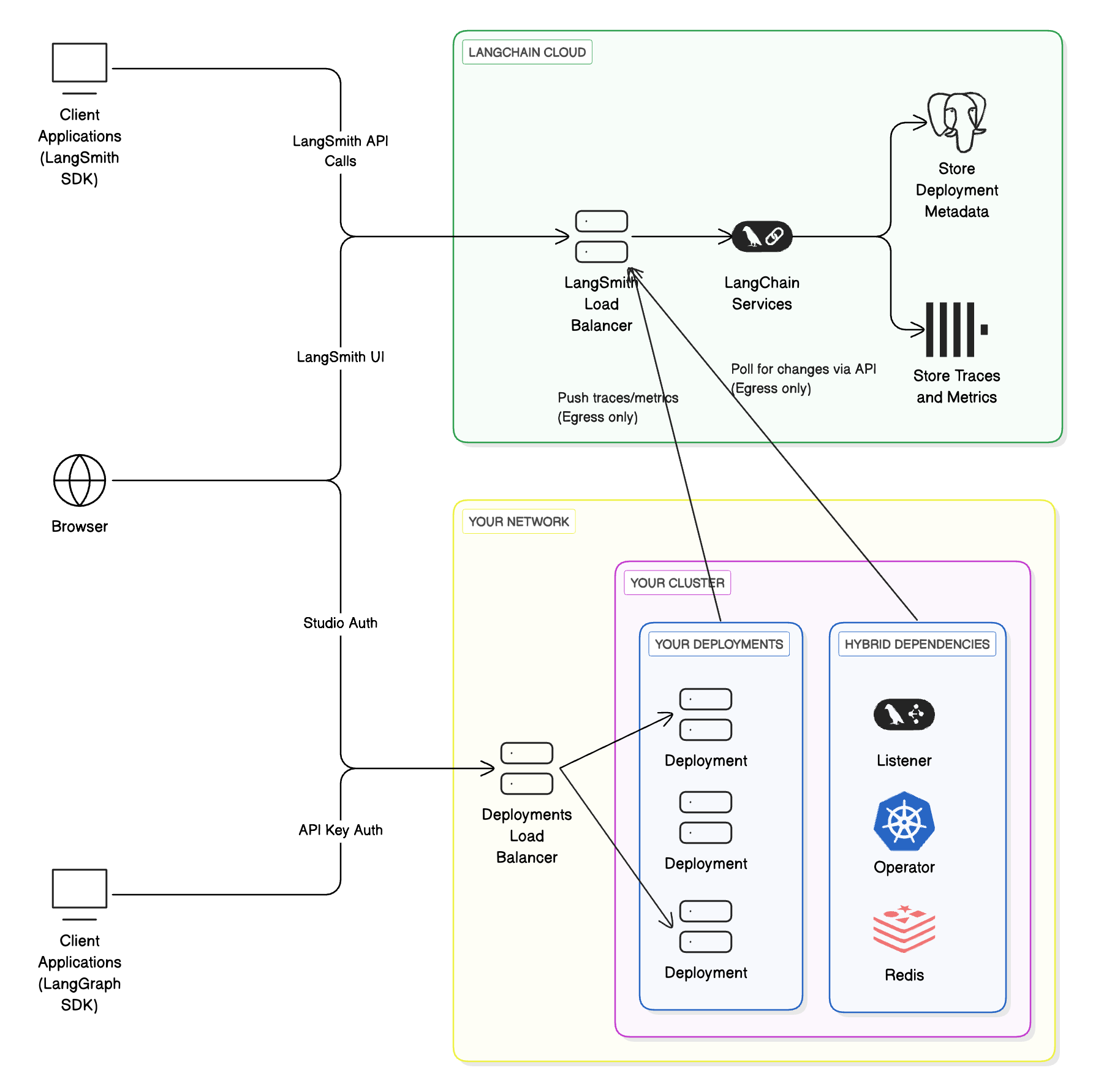
Compute Platforms
- Kubernetes: Hybrid supports running the data plane on any Kubernetes cluster.
Egress to LangSmith and the control plane
In the hybrid deployment model, your self-hosted data plane will send network requests to the control plane to poll for changes that need to be implemented in the data plane. Traces from data plane deployments also get sent to the LangSmith instance integrated with the control plane. This traffic to the control plane is encrypted, over HTTPS. The data plane authenticates with the control plane with a LangSmith API key. In order to enable this egress, you may need to update internal firewall rules or cloud resources (such as Security Groups) to allow certain IP addresses.Listeners
In the hybrid option, one or more “listener” applications can run depending on how your LangSmith workspaces and Kubernetes clusters are organized.Kubernetes cluster organization
- One or more listeners can run in a Kubernetes cluster.
- A listener can deploy into one or more namespaces in that cluster.
- Cluster owners are responsible for planning listener layout and Agent Server deployments.
LangSmith workspace organization
- A workspace can be associated with one or more listeners.
- A workspace can only deploy to Kubernetes clusters where all of its listeners are deployed.
Use Cases
Here are some common listener configurations (not strict requirements):Each LangSmith workspace → separate Kubernetes cluster
- Cluster
alpharuns workspaceA - Cluster
betaruns workspaceB
Separate clusters, with shared “dev” cluster
- Cluster
alpharuns workspaceA - Cluster
betaruns workspaceB - Cluster
devruns workspacesAandB - Both workspaces have two listeners; cluster
devhas two listener deployments
One cluster, one namespace per workspace
- Cluster
alpha, namespace1runs workspaceA - Cluster
alpha, namespace2runs workspaceB
One cluster, single namespace for multiple workspaces
- Cluster
alpharuns workspaceA - Cluster
alpharuns workspaceB